PUBLICATIONS
"Cuban Resonances: Artistic Disobedience and Mediated Dissent in Contemporary Cuba"
Ethnic Resonances in Performance, Literature, and Identity
Editors: Yiorgos Kalogeras and Cathy C. Waegner
London: Taylor & Francis, 2020
ISBN: 978-0367859916
Raul's Chapter: Whereas an active global Cuban diaspora has, for close to 60 years, produced a large corpus of dissident and exilic texts outside of Cuba, any type of artistic transgression or creative dissidence inside of Cuba continues to be illegal, persecuted, and dangerous, with little improvement over the repressive era associated with the 1960s–1980s. These acts, whether taken by a peaceful Cuban women’s organization, a global hip-hop rapper, an internationally coveted performance and mixed-media artist, or a typical citizen expressing his or her personal opinions to a video camera, are still considered counter revolutionary in the current Cuban context, even after Fidel Castro’s death in the fall of 2016 and improved relations between the United States and Cuba during the second term of the Obama administration. This chapter interweaves contemporary cases that demonstrate Cuban disobedience with D. Travers Scott’s concept of dynamic resonance in contrast to static intertextuality to reflect the ever-amplifying connections among actions of dissent, various forms of media, and viral dissemination. A controversial film and novel by the Cabrera Infante brothers in the 1960s are examined as influential for AfroCuban emplacement, representation, and subsequent self-making of artistic activism. The chapter provides a contemporary approach to AfroCuban performance of nationality and mediated dissidence in order to contextualize the continued trajectory of AfroCuban discrimination and persisting racial inequity in current Cuba. Whether or not broader access to the Internet as of 2018 and a revised national constitution (ratified February 2019) will improve the situation of the disadvantaged AfroCubans remains to be seen.
Volume Description: This volume seeks to weave applications of the dynamic concept of resonance to ethnic studies. Resonance refers to the ever broadening, multidirectional effects of movement or action, a concept significant for many disciplines. The individual chapters exchange the concept of static "intertextuality" for that of interactive "resonance," which encourages consideration of the mutual and processual influences among readings, paradigms, and social engagement in cultural analysis. International scholars of literary and cultural studies, linguistics, history, politics, or ethno-environmental studies contribute their work in this volume. Each chapter examines a specific ethnic phenomenon in terms of relevant literature, lived experience and theoretical approaches, or historical intervention, relating the given case study to parameters of resonance. The book offers dialogic transnational interchange, a play of eclectic ethnic voices, inquiries, perspectives, and differences. The studies in this interdisciplinary volume show that – through resonant engagement with(in) and between works – literary production can both enhance and disturb cultural narratives of ethnicity.

"Cuban Emotions: Virtual & Material Storytelling in a Postnational Era"
Identidad y Postnacionalismo en la Cultura Cubana
Editors: Laura Alonso Gallo & Belén Rodríguez Mourelo
Valencia: Aduana Vieja, 2019
ISBN: 978-8494954689
Raul's Chapter: “Cuban Emotions: Virtual and Material Storytelling in a Postnational Era” which appeared in the book Identidad y Postnacionalismo en la cultura cubana (Aduana Vieja, 2019) edited by Laura P. Alonso Gallo (Barry University) and Belén Rodríguez Mourelo (PENN State University). In the chapter Rubio proposes that the concept of postnational has been taking traction over the last decade and is nascent within critical studies on global migrations, and particularly applicable to the Americas, Latinx Studies, and beyond. He considers it timely to broach and apply this framework to the case of Cuba in the twenty-first century as we approach 2020. Cuba has continued to be subject to almost sixty years of disjuncture given the socio-political positionality of the island. As such, in his analysis of artificial texts, via cyberspace, using a wide-range of technological platforms, a virtual nation has been forged. Equally relevant to the study, consumer objects (material goods) and entertainment have also become the junctures and spaces through which Cuban diasporic citizens connect. As a result his study proposes to encapsulate the formats, textures, and meanings of “emotional” charge in a set of cultural texts, including, transmedia, consumer-driven material objects, and site-specific texts.
Volume Description: This anthology is an invitation to think about the concept of belonging in contemporary terms, under the prisms of globalization, advances in communications and migratory movements. The authors present a compilation of texts that address the complex issue of Cuban identity interpreted from different contexts, with a global and post-national vision that goes beyond borders, opening to a current perception and, as a consequence, to thematic and cultural universes related to the reality of our time. Scholars featured in the book, include: Ruth Behar (University of Michigan); Nivia Montenegro (Pomona College); Rafael Rojas (El Colegio de México); Enrico Mario Santí (University of Kansas), among others.

"Cuban-American Food Narratives on Memory, Storytelling and Materiality"
Reading Cuba: Literary Discourse and Transcultural Geography
Editor: Alberto Sosa Cabanas
Valencia: Aduana Vieja, 2018
ISBN: 9788494640728
Raul's Chapter: An individual’s encounter with food creates memories, not only because ingestion is so sensorial but also because the acts of cooking, eating protocols, and sharing those experiences with others are equally memorialized. Place also prefigures in these memories, given that spatial-temporal memories, especially those that involve home and homeland, are associated with the nostalgic functions that these food encounters hold. Food memories are also continuously performed through our bodies, via day to day practices, via nostalgic trips to the past, as performed in our daily lives, and these practices supply the life narratives that individuals perform in any creative format chosen, whether writing, painting, collecting, or simply cooking. This essay entertains the idea of “memorializing” the nation through the production and consumption of food as an act of remembering and reconstructing the national, extraterritorially.
Volume Description: This bilingual volume compiles critical essays by scholars who invite readers to rethink their notions of the Cuban nation through a geographical lens considering exilic and diasporic realities. The anthology features prominent literary and cultural critics, including: Eliana Rivero, Rafael Rojas, Laura Alonso Gallo, Belén Rodriguez Mourelo, Santiago Juan-Navarro, and Vitalina Alfonso.
Volume Description: This anthology is an invitation to think about the concept of belonging in contemporary terms, under the prisms of globalization, advances in communications and migratory movements. The authors present a compilation of texts that address the complex issue of Cuban identity interpreted from different contexts, with a global and post-national vision that goes beyond borders, opening to a current perception and, as a consequence, to thematic and cultural universes related to the reality of our time. Scholars featured in the book, include: Ruth Behar (University of Michigan); Nivia Montenegro (Pomona College); Rafael Rojas (El Colegio de México); Enrico Mario Santí (University of Kansas), among others.

"Stand-up Comedy, Beyond the Stage: Mediated Ethnicity, Sexuality and Citizenship"
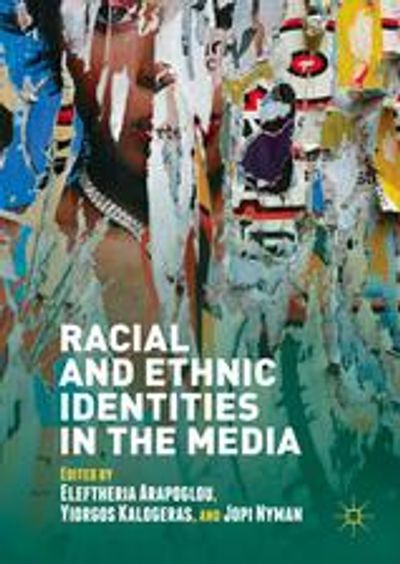
Racial and Ethnic Identities in the Media
Editors: Eleftheria Arapoglou, University of California, Davis; Yiorgos Kalogeras, Aristotle University, Thessaloniki, Greece; Jopi Nyman, University of Eastern Finland
Palgrave, 2016.
ISBN: 978-1-137-56834-2
Raúl's Chapter: Humor, in general, and stand-up comedy particularly, are popular and powerful mediums in contemporary culture. Rubio studies this art form based on both the textual analysis of comedic material and on the impact of this material throughout mediated means. He engages in the use of existent theoretical approaches based on the stand-up comedy genre, in connection with mediated expressions pertaining to queer ethnicity, sexuality, and citizenship. He argues that queer stand-up comedy, beyond entertaining, serves as a catalyst that mediates the understanding of differences. Both performers and their performances are catalysts of change. He studies the differences between experiencing live performance and the alternative that of accessing these performances via archived formats, most notably TV, the Internet, or recorded performances. Rubio broaches those pertaining to ethnicity and sexuality as observed in the work of queer stand-up comedians.
Volume Description: This volume examines the role and representation of ‘race’ and ethnicity in the media with particular emphasis on the United States. It highlights contemporary work that focuses on changing meanings of racial and ethnic identity as they are represented in the media; television and film, digital and print media are under examination. Through fourteen innovative and interdisciplinary case studies written by a team of internationally based contributors, including Robert Stam (NYU), Ella Shohat (NYU), as well as renowned list of media scholars and practitioners, the volume identifies ways in which ethnic, racial, and national identities have been produced, reproduced, stereotyped, and contested. It showcases new emerging theoretical approaches in the field, and pays particular attention to the role of race, ethnicity, and national identity, along with communal and transnational allegiances, in the making of identities in the media. The topics of the chapters range from immigrant newspapers and gangster cinema to ethnic stand-up comedy and the use of ‘race’ in advertising.
"Cuban Ethnicities in Cinematic Context, 1930s-1950s"
Handbook on Cuban History, Literature, and the Arts: New Perspectives on Historical and Contemporary Social Change
Editors: Mauricio A. Font & Araceli Tinajero
Routledge, 2014.
ISBN: 978-1-61205-679-1
Raul's Chapter: The goal of “Cuban Ethnicities in Cinematic Context, 1930s-1950s” is to consider the meanings behind the display of ethnicity as represented in three films that span the 1930s-50s, the latter part of Cuba’s Era as a Republic (1902-1959). While examining the potential meanings of these representations and their formats, Rubio explores how the urban realm, Havana, also plays an important role in these depictions. The three films analyzed in this piece, El Romance del Palmar (Cuba, 1938), El Mariachi Desconocido (Tin Tan en La Habana) (Mexico, 1953), and Week-end in Havana (US, 1941), bring to the table three different national perspectives on Cuba pertaining to the 1930s-1950s. All three, however, partake in demonstrating the use of ethnicity as common practice and as a nuanced stylistic practice within the popular culture of those times. The films and their respective perspectives offer a window into the socio-political situation of ethnic citizens in Cuba and the societal treatment they received.
Volume Description: The Handbook on Cuban History, Literature, and the Arts: New Perspectives on Historical and Contemporary Social Change (2014) edited by scholars Mauricio A. Font & Araceli Tinajero features research by leading academics from Cuba, the United States, and Europe. It is organized as collection of both discipline-based and interdisciplinary research from a wide-range of interconnected fields that span the social sciences and the humanities. The handbook’s purpose is to offer new perspectives on the historical archive, the literary and artistic canons, while embarking on the analysis of new contemporary interventions related to cultural and social activism.

"Corporality, Identity and Memory in the Performance Piece 'Rum & Coke' by Carmen Peláez"
Un Pueblo Disperso: Dimensiones sociales y culturales de la diáspora cubana
Editor: Jorge Duany
Aduana Vieja, 2014.
ISBN: 978-84-96846-94-4
Raul’s chapter, “Nostalgic Trips: Corporality, Identity, and Memory in the Performance Piece Rum and Coke by Carmen Peláez” explores the discourses of nostalgia that are evident in work of Cuban-American playwright and performer Carmen Peláez. In her solo performance piece Rum and Coke, Peláez physically embodies the lives of a handful of Cuban women on and off the island. Rubio’s essay concretely focuses on Peláez’s “narrative” on Cuba arguing that the dramaturgy of Peláez’s Rum and Coke text and performance is heavily connected to techniques of corporality, specifically the corporal experiences of the characters when dealing with Cuba and the Revolution, whether they are on the island or extraterritorially.
Volume Description: The idea of a Cuban diaspora has become widespread over the last decades. Given that for over fifty years there has been a growing dispersal of Cubans around the world, the idea of acknowledging, researching, and writing about Cuban diasporic cultures has taken a primary role in contemporary scholarship pertaining to Cuban and Cuban-American studies. This bilingual volume contains a selection of vetted and blind-refereed papers presented at the Ninth Conference on Cuban and Cuban-American Studies, sponsored by the Cuban Research Institute at Florida International University (FIU). The collection features scholarship by analyzes numerous aspects of Cuban and Cuban-American studies, including politics, economics, sociology, literature, music, religion, art, and cinema. The authors come from diverse disciplines of the humanities and the social sciences, particularly literary and art criticism, cultural studies, history, sociology, anthropology, and geography. The texts are published in Spanish and English, according to their authors’ preference, as a reflection of the bilingual character of Cuban-American culture. Many of the contributions included herein document the transition in the Cuban-American community from the historical exile toward a diasporic perspective—a transition notable in cultural fields such as narrative, popular music, and the visual arts. Aduana Vieja (Spain) is the premier heritage press of Cuban exile and diaspora studies, particularly literature and cultural studies.

La Habana: cartografías culturales
Author: Raúl Rubio
Aduana Vieja, 2013.
ISBN: 9788496846845
Raul's monograph La Habana: cartografías culturales examines the worldwide fascination with Cuba and things Cuban during the last century, particularly envisioning how the city of Havana, is more than a scenic backdrop, having become the nation’s most visible protagonist and its foremost player, perhaps second only to Fidel Castro. It offers a cutting-edge approach to the intersections between Cuban politics, ideology, national identity, and artistic production, both on and off the island. Organized through studies on a wide-range of artistic mediums, including literature, film, photography, and material products that are manufactured not only in Cuba but also globally, the book offers an alternative take on the complex state of contemporary Cuban national identity. Raúl employs the perspective that, given Havana’s isolated reality, it is the city’s image, a simulated cartography, what has become highly desired and perpetually reproduced by media and cultural sources. Havana, in that light, is therefore mostly accessible to the world through artificial means, mechanically reproduced as nuanced copies of the real city. The monograph is the culmination of Raúl’s long-range research on Havana’s symbolic appearance in Cuban-oriented cultural production of the last century. The book features both previously published scholarship that originally appeared in English between 2005-2012 and new research based on recent theoretical approaches and analysis related to Raúl's long-range interest in Cuban material cultures.

"Consuming Class: Identity & Power..."
Living with Class: Philosophical Reflections on Identity and Material Culture
Editors: Ron Scapp and Brian Seitz
Palgrave, 2013.
ISBN: 978-1-137-32681-2
Raúl's Chapter: What is "class" given the new realities which entail living in imaginative or artificial worlds that span global enterprise, social media, and the meanings associated with capital? Meanwhile, how do theories associated with Deborah Stone's concept of the polis that consider the meanings of community, social consciousness, civic responsibility, and sustainability reconceptualize class today? What is class anyway? Is consuming "class" an act of empowerment? How is class consumed? It the consumption of things and access to places and knowledge significant of consuming power? My premise is that in the ongoing era of consumption, class is power, and consumption is power, and therefore the existent practice is that class is gained through consumption.
Volume Description: It is clear that the world is in conflict about the status (quo) of capital. Living With Class: Philosophical Reflections on Identity and Material Culture addresses and reflects upon the many different ways in which and through which we find ourselves struggling, surviving, and thriving today. The contributors offers diverse considerations, 'ethnophilosophies,' about the force, subtleties, and consequences of the many different ways that capitalism, wealth, and poverty continue to dominate our lives and influence our sense of identity, our understanding of material culture, and our continued maintenance of class status. Following the current debates about wealth and class and the longing for a new discursive engagement with this historically defined concept, they examine the social and cultural phenomena of class from a uniquely innovative philosophical approach and reconsider certain philosophical "givens" within the context of culture in the broadest sense of the word, experientially and theoretically. Anthology contributors include: Henry Giroux, bell hooks, and Stanley Aronowitz.

“Subjetividad, alteridad y colectividad en Morir de glamour..."
Narratología y discursos múltiples: Homenaje a David William Foster
Editors: Daniel Altamiranda and Diana B. Salem.
Editorial Dunken, 2013.
ISBN: 978-987-02-6412-5
Raúl's Chapter: El glamour es evasivo pero los matices de su significado contienen un valor y un capital incalculable para sus creadores y seguidores. Este capítulo propone que el concepto de glamour sirve como un vehículo mediante el cual se realiza y se representa la identidad y la sexualidad. Por medio de una lectura analítica del libro Morir de glamour: crónica de la sociedad de fin de siglo por el venezolano Boris Izaguirre, examino el modo en que los conceptos de subjetividad y colectividad de la identidad desempeñan un papel en la naturaleza del glamour.
Volume Description: Narratología y discursos múltiples: Homenaje a David William Foster (Dunken, 2013) gathers scholarship that has been influenced by the theoretical work of Professor David William Foster, Arizona State University, whose scholarship on alternative identities, sexuality, and marginality, has greatly impacted Latin American literary and cultural studies during the last forty years. The anthology features a jury-vetted and peer-reviewed selection of the papers that were presented at the 2011 International Symposium offered by the Centro de Estudios de Narratología (CEN) in Buenos Aires at the Biblioteca Nacional. Among the collaborators from Spain, Argentina, and the United States, are Gabriela Cittadini (Fundación Internacional Jorge Luis Borges), Daniel Halcombe (Arizona State University), and Jean Graham-Jones (The Graduate Center, CUNY).
"Framing the Cuban Diaspora: Representation and Dialogue in Recent Filmic Productions"
Cuba: Idea of a Nation Displaced
Editor: Andrea Herrera
SUNY, 2007.
ISBN: 978-0-7914-7199-9
Raul's Chapter: The chapter "Framing the Cuban Diaspora" recapitulates and analyzes a select group of contemporary filmic productions that frame the Cuban diasporic experience, through an analysis of the following categories of films: non-Cuban, foreign films; diasporic films produced outside the island; US ethnic films produced by Cuban Americans; and Cuban films that dialogue with and about the diaspora. The films analyzed in the chapter portray the Cuban diaspora as fluid, ongoing and, at times, elusive, countering the purported “official” Cuban exile discourse that has been traditionally associated with Cuban Miami.
Volume Description: Cuba: Idea of Nation Displaced (SUNY, 2007) features contributions by internationally recognized artists, philosophers, and writers who reflect on the idea of a diasporic and displaced nation. Through a comprehensive portrayal of perspectives, inclusive of academic essays, testimonials, interviews, and literary pieces, the collection vividly re-examines what it means to be Cuban in a transnational context. The editor, Andrea Herrera, is Professor of Ethnic Studies at the University of Colorado, Colorado Springs, and the contributors include renowned scholars, Isabel Álvarez Borland, Antonio Benítez-Rojo, María Cristina García, William Navarrete, Eliana Rivero, Rafael Rojas, and Carlos Victoria. The collection gives voice to the complex and often-antagonistic cultural-political debates coexisting within the Cuban exile population. As a multi-voiced text, the anthology formulates a deeper understanding of diasporic identity, and broadens the discussion of the manner in which Cuban cultural identity and nationhood have been constructed, negotiated, and transformed by physical and cultural displacement.